
“This is your desk,” he said.
He never actually shared his name. When he saw that my ID matched his list, he told me to follow him. Between the lobby and my corner of the fourth floor, he didn’t say anything at all. When I say “my corner,” I mean that collectively. Six desks were crammed into the cubicle, three on either side, and the five interns already there had to suck in their stomachs and pull their chairs tight to their desks for me to pass.
“Username is last name, first name. Your password is your birthday. Log in, change your password, and then start the orientation module.”
And he was gone.
“They’re not being rude,” the woman next to me whispered. She was noticeably petite and wore dark-rimmed glasses. “They’ve got a pile of reports to process before end of day. We’ve had a rash of dungeon crashers, and it’s created a mess.”
I nodded.
“Dungeon crashers are people who sneak into dungeon gates,” she added.
“I knew that.”
“Wasn’t trying to be rude either.”
I raised my hands. “No, no, it’s okay. I didn’t take it that way.”
“Good. We get kicked around a lot. You need a thick skin. I’m Megan, by the way.”
“Dorion.”
She raised an eyebrow.
“My mom liked books.”
“Right. Sure. I’ll stop bothering you.”
I sat. My chair wobbled, and the hard plastic frame beneath the cushion poked through. The mouse felt cheap, and the login screen hung for a frustratingly long amount of time. I changed my password, and I started orientation.
The Center for Dungeon Management was a well-known federal agency, so I learned relatively little from the 127 slides I cycled through. Most of it was recent history.
For reasons still unknown, dungeon gates appeared around the world, and humans everywhere were introduced to the system. Pretty quickly, we figured out that not running dungeon gates led to dungeon surges, which loosed all manner of monsters into the world. Adjusting to the new normal sowed a great deal of chaos and ended an untold number of lives.
That was seventy years ago. We only recently reclaimed South America for humanity, so talks had begun about doing the same for Asia, an even bigger challenge. My grandfather was alive for the beginning of all of this, and he described pre-dungeon-Asia as having the most populated countries in the world. Multiple historians believed that China and India in particular had the capacity to become global powerhouses of technology and manufacturing.
That was always hard for me to picture. How could so many people lose to monsters?
Japan and Taiwan, who survived because of their island isolation, blamed Europe. The bar corner pundits would say those countries had to put the onus on Europe because dead Soviets can’t take responsibility or pay restitution. It was more profitable to pitchfork the countries still around. Anyone not from Japan or Taiwan blamed the Soviet Union.
The gates opening so soon after World War II hastened the Soviet Union’s demise, and no one disagreed with that conclusion. Not only was the country mired in corruption, but its people still reeled from 25 million war casualties and an extreme shortage of resources. The dungeon gates they knew about were rarely closed, but it was the gates they didn’t know about that ultimately led to Asia’s fall, or so we were taught in high school history.
Back then, we had no way to detect the appearance of gates in isolated areas and vastly underestimated how many there could be. We now know that gates have an equal chance of appearing on land anywhere in the world, so the vast frozen stretches of uninhabited Soviet Union land were just as likely to get a gate as Manhattan. The difference was no one was around to witness most of the gates in the Soviet Union, so no one closed them.
The Soviet Union’s legendarily brutal winter killed many of the monsters that emerged from gates, but eventually ice-type monsters surged. They thrived in the cold, naturally, and the more isolated villages had no way to fight them and no way to call for help. In other words, the people who might have sounded the alarm never got the chance.
Then spring came, and all manner of monsters surged forth to join the ice-type monsters.
The Soviet Union refused outside help and was overrun. By the time the rest of the world realized intervention was a necessity in everyone’s best interests, so many dungeon gates had surged that nuclear strikes seemed like the only option.
The Center for Dungeon Management, or CDM, didn’t give a shit about what happened in Asia. They only beat this story to death because it was the ultimate justification for their existence. Without the CDM managing gates and crawlers, American society was doomed to fall, just like the communists.
Finally, I reached the final registration step of the orientation module. This was all information I had submitted before on multiple occasions. Allegedly, they asked new hires to repeatedly fill in the same forms in an effort to catch falsified profiles, like someone hiding their level or their class.
After working there, I laugh when anyone acts like the repetitive data entry is by design. It wasn’t. We had three databases that depended on crawler profiles. None of them could sync to one another, and we didn’t have budget for an IT project that big.
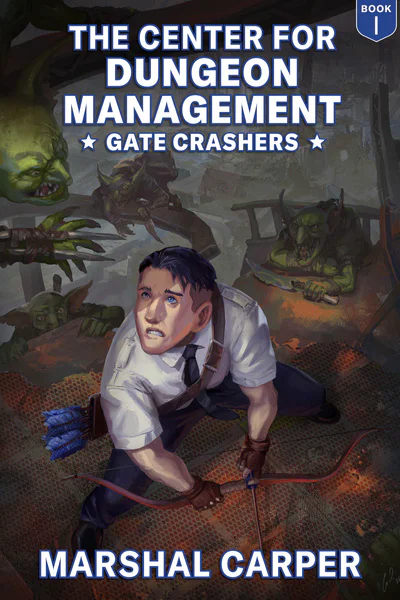
When I finished my intake, it looked just like my system profile:
Dorion Carmino
Class: Archer
Level: 1
XP Progress: 1/100
Str: 4
Dex: 5
Con: 4
Int: 3
Cha: 3
Abilities: (none)
Traits: Ranged Accuracy
Spells: (none)
My 1 XP came from killing fifteen giant rats when I was a kid. I was in the loft of a barn when I spotted the monsters below. I dropped hay bales on them and got in trouble for ruining all that perfectly good hay with rat guts.
I told myself that every intern started with system profiles like mine. I didn’t know the other five interns working around me, but I suspected they were there for the same reason I was: a job at the CDM was our only chance to earn XP. We couldn’t afford licenses or dungeon fees to earn XP on crawls, and grinding the wilds was as dangerous as it was impractical.
Any monster that escaped a dungeon was considered “wild,” and the areas overrun by such monsters were called “the wilds.” Though these were all monsters that once inhabited dungeons, the system made their XP value nearly worthless when they crossed over into our world. A 500 XP kill in a dungeon was a 5 XP kill when that same monster went wild. No change in difficulty. Just less XP.
The mana crystals found inside monsters remained after they escaped a dungeon gate, but they were useless black charcoal if you cut them out, so there was no money to be had in wild monster hunting either.